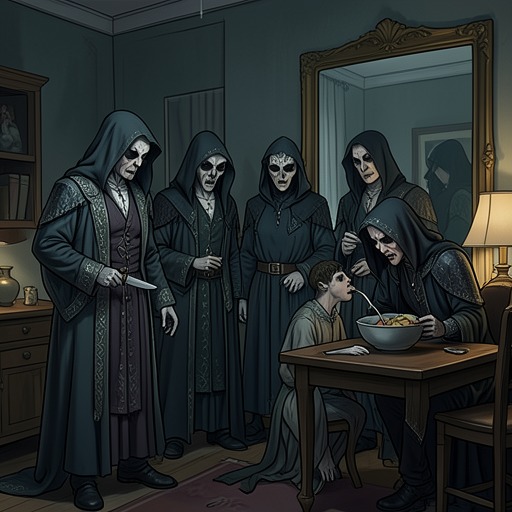
Humans Are Not Food
Living with 7 vampiresHumans Are Not Food is a vampire prohibition whose clearest formulation appears when Suga stops Jackson from approaching the abandoned infant. The rule establishes that human beings are not to be treated as prey, but the surrounding scenes make its force deliberately unstable: some vampires defend it as a moral limit, while others approach humans with hunger, violence, or concealment. Its importance lies in this contradiction. The prohibition is not merely background etiquette; it is the standard by which the vampires’ conduct, loyalties, and claims to restraint are judged.
The Rule and Its First Moral Test
The rule is stated during a flashback to Y/N’s infancy. A baby has been left alone, and Jackson walks toward the crying child, calling the infant noisy and reaching out to take her. Suga intervenes before Jackson can act, insisting that humans are not their food. Jackson answers by accusing Suga of hypocrisy, pointing out that Suga goes hunting every night. Suga distinguishes his own conduct by replying that at least he does not kill, turning the prohibition into a division between kinds of feeding rather than a simple rejection of vampire hunger. Mark and Bambam then help defuse the confrontation: Mark complains that the group no longer wants cranberry juice, while Bambam urges them not to start a fight in the middle of town. After the others disappear, Suga looks more closely at the baby, who has stopped crying, and warns her to be careful because she cannot know what creatures may be present. The scene therefore presents the rule through an act of protection, but also places that protection beside appetite, rivalry, and the possibility of lethal violence.
Violation and Concealment
The later treatment of Y/N shows how far the vampires can depart from their own stated boundary. Y/N feels lips on her collarbone, then a sharp pain, and discovers that he is drinking her blood while covering her mouth as tears run down her face. Her immediate thought is that she believed she could trust him, which makes the violation a breach of both bodily safety and personal confidence. The scene does not erase the rule; it exposes the cost of breaking it. Human blood becomes a source of control, pain, and terror, while the vampire’s earlier claim to live by restraint is rendered morally suspect.
The prohibition also produces a culture of secrecy around human contact. When J-Hope fears that a green-eyed figure may have seen Y/N, he instructs her to claim that she is lost and was merely walking through the woods, and to reveal nothing about the vampires. This warning does not directly restate the ban on feeding, but it shows that human beings and vampires inhabit incompatible circles of knowledge. Protecting the human requires concealment, rehearsed explanations, and strict control over what can be said. J-Hope directs Y/N to RM for further information, suggesting that the rule exists within a larger system of vampire knowledge and defensive procedures rather than as an isolated personal preference.
A Boundary Under Pressure
The story repeatedly places human bodies at the point where the prohibition becomes difficult to sustain. Y/N is attacked by an enormous water snake or similar creature after attempting to escape a dangerous situation, and later a medical examination discovers various holes in her body. Jin dismisses the wounds as the work of their cat, provoking Suga’s immediate agreement. The invented explanation conceals the physical evidence of supernatural violence from medical scrutiny. Human vulnerability is thus managed through competing forms of knowledge: the doctor examines and records the body, while the vampires replace the true cause with a harmless domestic fiction.
The rule’s broader setting is a world where vampires can be hunters, protectors, captors, and subjects of control at once. Jimin tells Y/N that she should always look at a person’s eyes, while the presence of green-eyed beings makes ordinary recognition dangerous; Jin’s normal-looking face and eyes later contrast with the blood covering his hands. These moments complicate the distinction between appearance and conduct. A vampire may look ordinary while violating the human boundary, and a warning about the eyes may itself become a survival instruction. Humans Are Not Food therefore functions as an ethical demand that must be tested against appetite, disguise, injury, and the unstable identities produced by supernatural transformation.
Enforcement, Exceptions, and Concealed Authority
The prohibition is enforced unevenly, revealing that its practical meaning depends on who has power over the human body. Suga’s intervention at the abandoned infant is direct and immediate: he prevents Jackson from treating a vulnerable human as an available meal, then frames his own nightly hunting as acceptable because he does not kill. That distinction creates an internal hierarchy of restraint. The rule does not abolish predation; it defines a limit within it, separating controlled feeding from murder and making the vampire community responsible for deciding where that boundary lies. The group’s hurried departure from the town, urged by Bambam, further suggests that even a protective act must remain discreet when humans and vampires meet.
The rule also illuminates the story’s larger system of supernatural authority. Human beings are not simply prey; they are bodies subject to competing claims of protection, secrecy, diagnosis, feeding, and transformation. Jin’s insistence that Y/N would find life better with the vampires, despite her immediate refusal to remain, shows how protection can become possession when the protected person is denied a meaningful choice. The same coercive logic appears when Y/N is warned to conceal the vampires’ existence, when her injuries are explained away as animal bites, and when her body becomes the site of unexplained pain and blood loss. Even the revelation that Gehan rules Gehenna and Y/N’s decision to lock its gate extend the rule’s implications beyond individual appetite: the question is not only whether a vampire will consume a human, but who may define the limits governing human life, who may enforce them, and whether any authority can claim to protect a person while treating that person as an object of its own order.
Narrative Significance
Humans Are Not Food ultimately operates less as a stable law than as a moral test repeatedly exposed to pressure. Suga’s defense of the abandoned infant gives the prohibition its strongest form: a vulnerable human is recognized as someone who must not be killed merely because hunger makes her accessible. Yet the surrounding narrative refuses to let that protection remain uncomplicated. Jackson approaches the baby, Suga admits that he hunts, and the distinction between feeding without killing and treating a human as prey leaves the community’s ethics dependent on degrees of violence rather than absolute safety. Y/N’s later experience sharpens the contradiction. Her blood is taken while her mouth is covered, her injuries are hidden behind the explanation of a biting cat, and her continued presence among the vampires is presented as beneficial even after she rejects the decision to keep her there. The rule therefore exposes a recurring conflict between protection and possession: the vampires may oppose murder while still controlling the human body, restricting her speech, concealing the truth of her wounds, and deciding where she should live. Its force lies in making those contradictions visible. Every appeal to restraint invites comparison with the conduct that follows, so the prohibition becomes the standard through which vampire loyalty, secrecy, authority, and violence are measured.